
What's Happening?
Sacred Rhythms: Looking for God Along the Way
Deuteronomy 6:4-9; Luke 24:13-35
Sometimes we imagine that encountering God requires us to go somewhere special.
We set aside a quiet time for prayer. We come to worship. We open our Bibles. We look for those moments when everything seems to fall into place and God’s presence feels unmistakable.
But Scripture paints us another picture.
In Deuteronomy, God’s people are told to keep God’s presence woven into the ordinary rhythms of their lives – when they’re at home, when they’re travelling, when they lie down, and when they rise.
And then, in the story of the road to Emmaus, two disciples discover just how true that can be.
They’re just walking.
They’re talking about everything that has happened. They’re trying to make sense of their disappointment and confusion. And Jesus comes alongside them.
They don’t recognize him, at least not at first.
It is only later, when they look back, that they realize something sacred had been happening all along.
Maybe that’s part of the mystery of faith: God may be present long before we recognize God’s presence.
We don’t always need to find God. Sometimes we just need to be more attentive to where God is already walking with us.
So, sometime this week, take a walk with no particular destination in mind. Leave the headphones behind. Put away the phone. Let the walk itself become your goal.
As you begin, take a slow breath and pray:
“Christ, walk with me.”
Then just walk.
Notice what you see, hear, and experience along the way. Pay attention to the people you encounter, the beauty around you, the thoughts that arise, and the things that catch your attention.
You don’t need to interpret anything. Just notice. At some point during your walk, ask:
“Where might Christ be walking with me today?”
Let the question sit in your thoughts.
When your walk is finished, take a moment to look back over your journey. Is there something you noticed that you might otherwise have missed? A moment of beauty? A thought that stayed with you? A person who crossed your path? A sense of peace or gratitude?
Give thanks for whatever you encountered. And remember the disciples on the road to Emmaus. They didn’t recognize Jesus while he was walking beside them. Sometimes we may only recognize God’s presence when we look back and realize:
“My heart was being opened along the way.”
Let’s pray
Christ who walks beside us, Open our eyes to your presence in the ordinary paths of our lives. Help us slow down, pay attention, and recognize the moments when you are already walking with us. May we discover that no part of our journey is beyond your presence. Amen.
Mid-Week Moment: Whole and Welcome
Galatians 3:23-29
There are places where we learn to leave parts of ourselves at the door. Maybe we leave behind the parts that feel too different. The questions we are afraid to ask. The experiences we don’t know how to explain. The identity that someone once told us was unacceptable.
We learn, sometimes without even realizing it, how to make ourselves a little smaller so that we can fit. But the gospel offers us another possibility.
In his letter to the Galatians, Paul writes that in Christ there is no longer Jew or Greek, slave or free, male and female. For Paul, these were significant divisions, identities and categories that shaped how people understood themselves and one another.
Paul isn’t saying that these differences suddenly cease to exist. He is saying something much more radical:
They no longer determine who belongs.
Our differences do not have the power to decide who is worthy of God’s love. And that matters because our identities matter. For many of us, the words we use to describe ourselves are not simply labels. They carry stories.
Some identities are inherited. Some are chosen. Some take years to understand. Some are discovered only after a long struggle to find the words that finally feel true.
Claiming an identity can be a deeply meaningful part of becoming whole. After being told that some fundamental part of who we are was something to hide or be ashamed of, finding the courage to say, “This is who I am,” can be an act of profound honesty.
The Christian response should never be, “You need to leave that part of yourself at the door.” Instead, the gospel invites us to bring our whole selves.
Our identities.
Our stories.
Our questions.
Our joys.
Our scars.
Our hopes.
All of it.
Because God’s love is not waiting for us on the other side of becoming someone else. God meets us as we are.
And that’s one of the most beautiful things about Paul’s words: we don’t become one by becoming the same. The church is not meant to be a place where everyone has to fit the same mould. It is meant to be a community where different people discover that there is room for them, room for all.
So maybe the question for the church is:
“Have we created a place where people can actually bring their whole selves through the door?”
There is a difference between being welcomed and belonging. Welcome says, “You can come in.” Belonging says, *“You don’t have to hide once you’re here.”
And the vision Paul offers is even greater than that. In Christ, we are not merely tolerated. We are one. And it’s not because our differences disappear, but because God’s love is greater than the divisions we use to separate one another.
Whatever names we carry, whatever stories have shaped us, whatever identities help us understand who we are, none of them places us beyond the reach of grace.
You don’t have to leave yourself at the door.
God has already made room for you.
Take some time to sit with the reading from Paul’s letter to the Galatians, and use these questions to guide your reflections:
- Are there parts of yourself you have ever felt you needed to hide in order to belong?
- What identities or experiences have helped you understand yourself more fully?
- How might the church move beyond simply saying “everyone is welcome” toward creating genuine belonging?
- Who might need to hear, through our words or actions, “You don’t have to leave yourself at the door”?
Let’s pray:
Loving God, thank you for creating us in all our beautiful differences. Remind us that we do not need to become someone else to be loved by you. Give us courage to bring our whole selves into your presence, and compassion to make room for others to do the same. May your church become a place where no one needs to hide, and where every person knows they belong, and they are loved. AMEN
Sacred Rhythms: Remembering Who You Are
Galatians 3:23-29
We carry a lot of identities with us. We are parents and grandparents, friends and neighbours, workers and volunteers. We are shaped by our families, our communities, our experiences, our successes, and our disappointments.
Some of those identities bring us joy. Others can become burdens we carry. And sometimes, without realizing it, we begin to measure our worth by them. Am I successful enough? Am I useful enough? Am I needed? Am I doing enough?
In Galatians, Paul offers us another place to begin. He reminds the early Christian community that through Christ, they have become children of God. Before all the other things that describe us, there is this deeper identity: we belong to God.
That identity isn’t something we have to earn. It isn’t dependent on what we accomplish, how others see us, or whether we get everything right.
It is a gift.
And maybe part of growing in faith is learning to remember who we are, not because we have forgotten completely, but because the world gives us so many other things to remember.
This week, before reaching for your phone, checking the news, or beginning the day’s responsibilities, take a moment to breathe. Place your feet on the floor and simply become aware that you are here. Then say quietly:
“I am a beloved child of God.”
Take a breath.
Repeat it again:
“I am a beloved child of God.”
You don’t have to make yourself feel anything in particular. You don’t have to prove the words are true. Just say them.
As you move through your day, notice the moments when you begin to measure yourself by something else – your productivity, someone else’s opinion, a mistake you made, something you wish you had done differently, or something you feel you should have accomplished.
When you notice it, pause and return to the prayer:
“I am a beloved child of God.”
Let that be enough for a moment. At the end of the day, take one final breath and ask:
“How did remembering who I am change the way I moved through today?”
You may discover that knowing who you are doesn’t necessarily change your circumstances. But it can change the place from which you meet them.
You don’t have to earn your place at God’s table. You don’t have to prove that you belong. You are already God’s beloved. Remember who you are.
Let’s pray:
Loving God, when we forget who we are, remind us that we are your beloved children. Help us receive your love without needing to earn it, and carry that knowledge into everything we do. May your love become the foundation from which we live, serve, and love others. AMEN
Mid-Week Moment: What Are You Growing?
Galatians 5:16-26
If you planted a garden today, you wouldn’t expect to walk outside tomorrow and find it overflowing with ripe fruit. Growth takes time.
It begins beneath the surface, often long before anything becomes visible. Roots develop. Shoots emerge. Leaves appear. And slowly, eventually, fruit begins to form.
Paul uses this image when he talks about the life of faith. He doesn’t just give us a list of things we are supposed to be. He speaks about fruit. Love. Joy. Peace. Patience. Kindness. Generosity. Faithfulness. Gentleness. Self-control.
We sometimes turn these words into a kind of spiritual checklist. Am I patient enough? Am I kind enough? Why don’t I have more joy? I really need to work on my self-control or gentleness.
And before long, the fruit of the Spirit becomes another way of measuring ourselves. But fruit isn’t something we manufacture by trying harder. Fruit grows.
A healthy tree doesn’t strain to produce an apple. It just grows as it is rooted, nourished, and cared for.
The same is true of us.
The question moves from: “What am I trying to become?” to: “What am I cultivating within myself?” because our lives are always growing something.
The things we give our attention to. The conversations we have. The people we surround ourselves with. The stories we tell ourselves. The habits we practice. The ways we respond when we are frustrated or afraid. All of these things are like water and sunlight for the soil of our lives.
And eventually, something grows. Sometimes it is beautiful. Sometimes it is something we wish we could pull out by the roots. That isn’t a reason for shame. It is an invitation to pay attention. If we notice that impatience is growing, we can begin cultivating patience. If fear has taken root, we can make more room for trust. If resentment has been growing unchecked, we can begin the slow work of forgiveness.
And if love, joy, peace, or kindness are already growing – even in small ways – we can notice those things too.
We aren’t called to become perfect gardeners overnight. We just need to become attentive to the soil.
Paul’s invitation is to walk with the Spirit, allowing God to shape what grows within us, and that takes time. There will be seasons when growth is obvious. There will be seasons when nothing seems to be happening. There will even be seasons when the garden needs pruning. But God is patient with growing things.
So this week, instead of asking yourself whether you are doing enough, try asking a different question:
What am I growing?
And then ask:
What would I like to grow more of?
Take some time to sit with the Galatians reading, and use the following reflection questions as a guide:
- What qualities or attitudes seem to be growing most naturally in your life right now?
- What might you be cultivating through the things you give your time and attention to?
- Is there something you would like to see grow more deeply in you, like patience, joy, peace, kindness, or courage?
- What is one small thing you could do this week to create better conditions for that growth?
Let’s pray:
Spirit of God, help us pay attention to what is growing within us. Where love is growing, help us nurture it. Where fear or resentment has taken root, meet us with your grace. Give us patience with ourselves as we grow, and teach us to trust your work within us. May our lives become fertile ground for love, joy, peace, kindness, and grace. AMEN
Sacred Rhythms: Practicing the Pause
Galatians 5:16-26
We live in a world that seems to expect an immediate response.
We react to messages, headlines, conversations, frustrations, and disagreements almost before we’ve had time to think about them. Sometimes our reactions are helpful. Sometimes they aren’t.
And our faith lives aren’t always different.
We can react to difficult questions before we’ve really considered them. We can react to someone who challenges us before we’ve listened. We can react to disappointment, uncertainty, or conflict before we’ve given ourselves time to wonder what God might be doing in the midst of it.
But there is a difference between reacting and responding.
A reaction is often immediate. It comes from instinct, emotion, habit, or whatever happens to be closest to the surface.
A response has room in it. It gives us time to listen, to think, to pray, and to consider what might be faithful.
In his letter to the Galatians, Paul encourages us to “live by the Spirit.” He describes the fruit that grows when we allow the Spirit to shape our lives: love, joy, peace, patience, kindness, gentleness, and self-control.
Perhaps one way we can practice living by the Spirit is by creating a little more space between what happens to us and what we do next.
It’s not so that we can suppress our feelings or avoid difficult things. Rather it is so we can respond to life with our whole selves rather than simply reacting from our first impulse.
This week, whenever you notice yourself having a strong reaction, practice pausing before you respond.
Take one slow deep breath. Notice what you’re feeling. Then ask:
“Spirit of God, how are you inviting me to respond?”
You don’t need to have an immediate answer, that’s not the point. Sometimes the faithful response will be to speak. Sometimes it will be to listen. Sometimes it will mean changing your mind. Sometimes it will mean holding your ground. Sometimes it may simply mean waiting until you have had time to understand what is really happening.
This same practice can be used with your faith.
If you encounter a difficult passage of Scripture, a challenging question, or something that unsettles your understanding of God, resist the urge to immediately resolve it.
Pause. Sit with it. Pray about it. Give God room to work in the questions as well as the answers. At the end of each day, think of one moment when you paused before responding.
Ask yourself:
“What was possible because I didn’t react immediately?”
You may discover that the pause didn’t make every situation easier, but it may have created enough space for patience, wisdom, compassion, or courage to enter the conversation.
That small space is sacred. It is a place where we can remember that we don’t have to let our first reaction decide who we will be.
We can pause. We can listen. And then, with the Spirit beside us, we can respond.
Let’s pray:
Spirit of God, slow us down when we are tempted to react too quickly. Give us the patience to pause, the wisdom to listen, and the courage to respond faithfully. In the space between what happens and what we do next, remind us that you are there. Amen.
Mid-Week Moment: Grace Can Redirect Us
Galatians 1:11-17
Sometimes we imagine that a changed life means leaving everything behind: a new beginning, a completely different person, or clean break with the past.
But Paul’s story suggests something a little more complicated, and maybe much more hopeful. Before Paul became an apostle, he had been passionately committed to a different path. He describes himself as someone who had persecuted the church and tried to destroy it. His passion was real. His convictions were strong.
He was simply headed in the wrong direction. Then grace found him. And grace didn’t erase his passion. It redirected it. The same intensity that had once been used against the followers of Jesus became energy for sharing the good news of Christ. Paul didn’t become someone who cared less. He became someone whose caring had been given a new direction.
There is something hopeful about that. Because most of us have things in our past we wish we could change, decisions we regret, priorities that got out of balance, relationships we mishandled, or time we spent chasing things that ultimately didn’t matter.
But maybe grace doesn’t always ask us to throw away our entire story. Sometimes grace takes what is already there and turns it toward something new.
Our experiences can become compassion. Our mistakes can become wisdom. Our struggles can deepen our understanding of someone else’s pain. Our passions can be redirected toward something that brings life. Even the things we once thought defined us can become part of a larger story.
That doesn’t mean everything that has happened to us was God’s plan. It doesn’t mean harmful choices suddenly become good because something meaningful comes afterward. It means that God’s grace is not easily defeated by our past.
There is still room for change. There is still room for growth. There is still room for a different direction.
The question isn’t just, “What do I need to leave behind?” It is also: “What might God be able to redirect?”
Grace doesn’t always make us into completely different people. Grace helps us become more fully the people we were created to be.
And that is the invitation this week: Don’t assume that your story is finished. Don’t assume that your past has determined your future. Stay open to the possibility that God is still redirecting your life toward love.
Take some time to sit with the reading this week and reflect on the following questions:
- Is there something from your past that you once saw only as a mistake but can now see as a source of wisdom or compassion?
- What gifts, passions, or experiences might God be inviting you to use in a new direction?
- Where in your life do you sense a gentle nudge toward change?
- What would it mean to trust that God’s grace is still at work in your story?
Let’s pray:
Gracious God, you meet us in the midst of our stories, not waiting for us to become perfect before you begin your work. Take what we have been, what we have learned, and even what we regret, and help us turn toward life. Redirect our passions toward love, our experiences toward compassion, and our gifts toward service. Remind us that our stories are not finished, and that your grace is always making room for something new. AMEN
Sacred Rhythms: Listening for God’s Call
Galatians 1:11-17
When we hear the word “calling”, we sometimes imagine something dramatic. A sudden revelation. A life-changing decision. A clear sense that God has something extraordinary planned for us.
Paul’s story certainly has that kind of drama. His encounter with Christ completely redirected his life and set him on a new path.
But not every calling comes with a moment as dramatic as Paul’s. Sometimes – most of the time – God’s call comes quietly. It might sound like a persistent thought to reach out to someone, a desire to use a gift you have been neglecting, a sense that it is time to let something go, or simply a growing awareness that God is inviting you to take one small step in a new direction.
Calling doesn’t always mean “Go somewhere else.” Sometimes it means “Pay attention to what is happening right here, right now.” The challenge is that our lives are full of voices telling us what we should do. Family, friends, culture, expectations, responsibilities, even our own fears can all speak loudly.
Listening for God’s call begins by making enough space to hear something quieter.
This week’s spiritual practice invites us into that sacred kind of listening. So I invite you to set aside a few quiet minutes each day this week. Take a few slow breaths and let yourself become still.
Then ask God one simple question:
“What are you inviting me toward?”
Don’t rush to find an answer. Just sit with the question. Notice what comes to mind. Maybe it’s a person, a possibility, a concern, a gift, or something you’ve been putting off. Maybe nothing comes to mind at all. That’s okay too.
If something does surface, don’t immediately assume it is a command. Simply hold it gently and ask:
“Does this invitation lead me toward love, compassion, courage, peace, or deeper life?”
You might even write down what you notice. Over the course of the week, look for patterns. Sometimes God’s call becomes clearer through the same gentle invitation appearing again and again.
And remember: you don’t need to know the entire journey. You only need to listen for the next faithful step.
Paul didn’t begin with a complete map of his future. He simply responded to the encounter with Christ that changed the direction of his life.
Maybe the same can be true for us. We listen. We notice. And when the invitation becomes clear, we take the next step.
Let’s pray:
God who calls us, quiet the voices that crowd our hearts and help us make space for you. Give us ears to hear your invitations, wisdom to recognize your voice, and courage to take the next faithful step. Wherever you are leading us, remind us that we do not walk alone. AMEN
Prayer Pause: What Truly Matters
This week’s Prayer Pause is for anyone who feels pulled in too many directions. For those carrying full calendars, busy minds, or hearts that long for something deeper. Inspired by Matthew 13:44-52, this prayer invites us to pause and remember that God’s kingdom is the greatest treasure we can discover, shaping what we value, what we pursue, and how we live.
God of every good gift, in a world that constantly tells us to want more, to do more, to be more, help us remember what truly matters. When we become distracted by collecting achievements, remind us that kindness is a greater treasure. When we become consumed by busyness, draw us back to the gift of your presence. When fear tells us to cling tightly to what we have, teach us the freedom of generosity. When we are tempted to measure our worth by what we accomplish, remind us that we are already beloved.
Today we pray for all who are searching: for purpose, for meaning, for hope, for something that will truly satisfy the deepest longings of the heart. May they discover that your kingdom is not found in wealth or achievement, but wherever love takes root, justice is pursued, mercy is offered, and hope is shared.
Shape our hearts to treasure what you treasure. Help us to value people more than possessions, compassion more than comfort,
relationships more than recognition, and your love above all else.
May the choices we make this day reflect the treasure we have found in you. For your kingdom is the gift that gives life, the hope that cannot be taken away, and the treasure that only grows as it is shared. AMEN

Mid-week Moment: What Is Your Treasure?
Matthew 13:44–52
Every one of us treasures something. It may not be gold or jewels hidden in a field, but there is always something that captures our attention, shapes our priorities, and quietly influences how we spend our days.
Sometimes it’s our family. Sometimes it’s our work. Sometimes it’s security, success, reputation, or comfort. Sometimes it’s the hope of a better future. Whether we realize it or not, what we treasure has a way of shaping the lives we build.
In Matthew’s Gospel, Jesus tells the story of a man who discovers a treasure hidden in a field. Filled with joy, he sells everything he has in order to buy that field. He tells a similar story about a merchant who finds a pearl of extraordinary value and gladly gives up everything to make it his own.
These stories aren’t really about money. They’re about value. The treasure changes everything because the man finally sees what is truly worth holding onto. That is one of the lifelong invitations of faith, to keep asking ourselves:
What is shaping my life?
It’s an easy question to answer with our words. But perhaps our calendars, our worries, our conversations, and the ways we spend our time reveal the answer even more honestly.
Jesus isn’t asking us to feel guilty about the good things we love. Family is a treasure. Friendship is a treasure. Beauty, laughter, generosity, and meaningful work are treasures too. But beneath all of those is an even deeper treasure: a life rooted in God’s love.
When we discover that love, when we begin to trust that we are deeply known, deeply forgiven, and deeply held by God, it has a way of changing everything else. Our relationships become richer. Our work finds deeper purpose. Our possessions become tools instead of masters. Even our fears begin to loosen their grip.
The kingdom of God doesn’t ask us to stop valuing the good things in life. It simply invites us to see them in the light of the greatest treasure of all. That is why Jesus tells these stories with such joy. When we discover what truly matters, life doesn’t become smaller. It becomes fuller.
Take some time this week to sit with the reading, and with the following reflections questions:
- What receives the greatest share of your time, energy, and attention these days?
- What treasures have brought lasting joy and meaning to your life?
- Are there things you have been treating as treasures that have left you feeling empty?
- How might your daily choices change if you began each day remembering that you are already held in God’s love?
Let’s pray:
Gracious God, thank you for the many gifts that bring beauty and joy into our lives. Help us to treasure what truly lasts. When we become distracted by things that cannot satisfy, gently draw our hearts back to you. May your love become the foundation of all we value, and may that love shape the way we live, give, and care for one another. Amen.
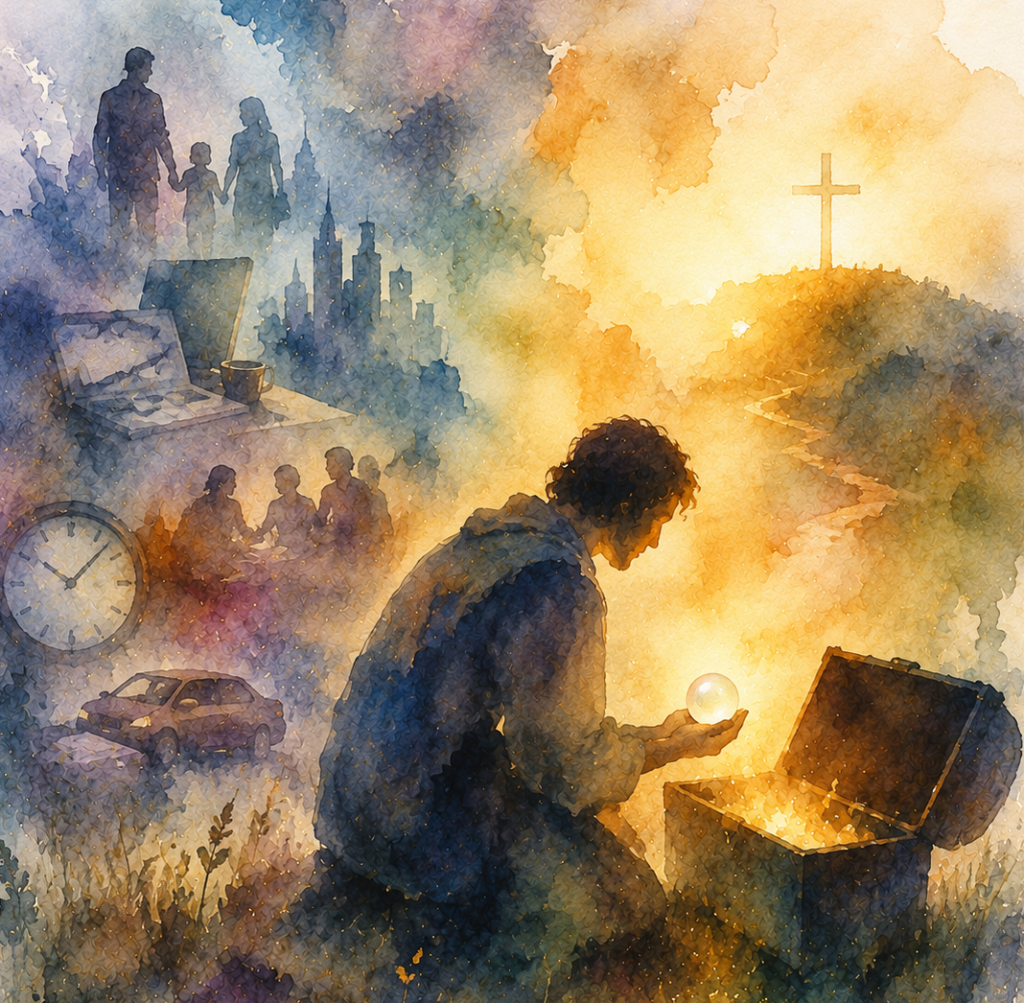
Sacred Rhythms: Treasuring What Matters
Matthew 13:44–52
What do you treasure? It’s a simple question, but not always an easy one to answer.
We often think of treasure as something valuable, rare, or worth protecting. Yet if someone were to look at our calendars, our bank statements, or the things that occupy our thoughts, they might discover what we truly treasure.
In Matthew’s Gospel, Jesus tells two short parables about a hidden treasure and a pearl of great value. In both stories, the people who discover the treasure respond with joy. They gladly let go of everything else because they have found something far more valuable.
Jesus isn’t asking us to reject the good things in life. Rather, he invites us to consider what holds first place in our hearts. The kingdom of God is not just another treasure to add to our collection. It is the treasure that reshapes the way we see everything else.
When we learn to treasure God’s presence, love, and grace, we begin to recognize that the richest parts of life cannot be bought or possessed. They are received as gifts.
This week, take a few quiet moments at the end of each day to reflect on what you treasured that day.
Ask yourself:
What brought life to my soul today?
Try to write down one thing that money could never buy.
Maybe it was:
- a meaningful conversation
- time with someone you love
- laughter shared with a friend
- a moment of peace
- an act of kindness
- forgiveness offered or received
- the beauty of creation
- a quiet awareness of God’s presence
As you write, give thanks for that gift. Then ask one more question:
Did I make room today for what matters most?
There is no need to judge yourself. Simply notice where your heart is being drawn.
Over time, this practice gently reorients us. It reminds us that the greatest treasures are often the simplest ones—the gifts of love, grace, hope, and community that God places before us each day.
Let’s pray:
God of every good gift, open our eyes to the treasures that truly matter. Help us to value your presence and to recognize the gifts of love, joy, peace, and grace that surround us each day. Shape our hearts so that what we treasure draws us ever closer to you. Amen.

46 Main Street
Fredericton, New Brunswick
E3A 1C1
506-458-9452 (Church Office)
506-262-2150 (Rev. Richard's Cell)
Office Hours
Tuesday - Friday 9am to 2pm
Rev. Richard's Drop-in Office Hours
Tuesday & Thursday 10:00AM to 12:30 PM
We dedicate the revitalization of our online presence to the memory of the late Mary Hicks. We are grateful for Mary’s personal estate bequest in support of the work and mission of Nashwaaksis United Church.