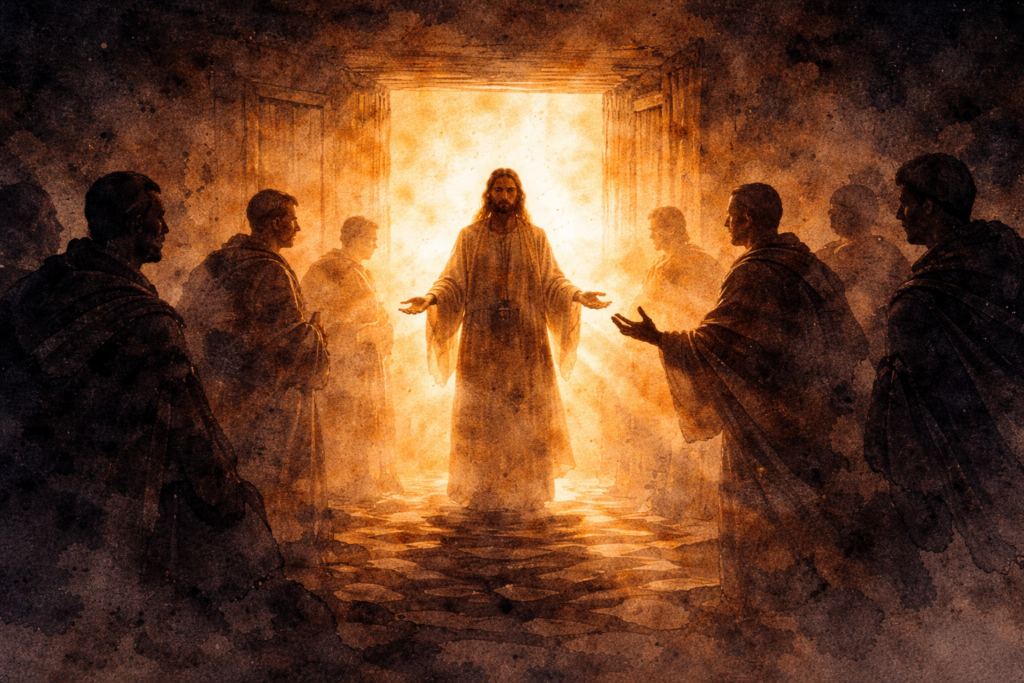
John 20:19-31
Not everyone arrives at resurrection in the same way. In John’s Gospel, the disciples encounter the risen Christ in a locked room. Fear still hangs in the air. Confusion has not yet cleared. Even after the miracle of Easter morning, they are still trying to understand what has happened. And into that confusion, Christ appears to greet and eat with his friends and followers.
But Thomas is not there.
When the others tell him the news – “We have seen the Lord!” – Thomas does not simply nod along. He does not pretend certainty. Instead, he responds with honesty:
“Unless I see the mark of the nails in his hands, I will not believe.”
For generations, Thomas has carried the nickname “Doubting Thomas.” But perhaps that label misses something important. Thomas is not cynical. He is not mocking faith. He is simply telling the truth about where he is. And Jesus does not reject him for it.
A week later, the disciples are gathered again behind those same locked doors. This time Thomas is with them. And once again, Jesus appears among them with the same words:
“Peace be with you.”
Then he turns directly to Thomas. Not with criticism. Not with shame. But with invitation.
“Put your finger here. See my hands. Reach out your hand and put it in my side.”
Jesus meets Thomas exactly where his questions live. There is something deeply comforting about this moment. It reminds us that faith does not require us to silence our questions. The risen Christ does not demand perfect certainty before showing up. Instead, he meets people in the middle of their searching.
Thomas needed to see and touch in order to understand. Others believed sooner. Both responses are part of the story. The path of faith is rarely identical from person to person. Some people experience belief like a sudden sunrise. Others come to it slowly, through conversation, questioning, and reflection.
And Christ walks patiently with both.
In many faith communities, doubt can feel like something we are supposed to hide. We worry that admitting uncertainty might weaken our faith or disappoint those around us. But John’s Gospel tells a different story. Thomas’ honest question leads to one of the most powerful confessions in the entire book. When he finally recognizes Jesus, he responds with words of deep devotion:
“My Lord and my God.”
Sometimes faith grows not in spite of our questions, but through them. Doubt can become a doorway. A doorway that leads us to seek more deeply, listen more carefully, and encounter Christ in ways we might never have imagined.
Easter does not demand perfect certainty. It invites us to bring our whole selves: our hope, our confusion, our trust, and our questions, into the presence of the risen Christ. And there, just as he did for Thomas, Jesus meets us with peace.
Take some time this week to sit with the reading – with Thomas – and reflect with the following questions:
- Have there been moments in your life when doubt was part of your faith journey?
- Why do you think Thomas needed to see and touch in order to believe?
- What questions about faith or life are you carrying right now?
- What might it mean to bring those questions honestly into Christ’s presence?
Following your reflection, take a deep breath, and pray.
Risen Christ, you meet us not only in certainty, but in our questions and searching. Give us courage to be honest in our faith, to bring our doubts and wonderings before you without fear or shame. Walk with us as we seek to know you more deeply, and speak your peace into every place of uncertainty. AMEN