
What's Happening?
Prayer Pause: Gifts We Don’t See
This week’s Prayer Pause is for anyone who has ever wondered if what they offer really matters. It is also for those whose quiet acts of love often go unnoticed. Inspired by Ephesians 4:1-16, this prayer reminds us that every gift – seen or unseen – helps the whole body grow in love.
Generous God, you have created each of us with something to offer. Some gifts are celebrated. Others are quiet and easily overlooked. Yet every gift matters to you.
Today we pray for those whose faithfulness often goes unseen. For those who listen with compassion. For those who encourage with gentle words. For those who prepare meals, offer rides, make phone calls, or simply show up when someone needs them.
Bless these gifts, and those who offer them.
Open our eyes to the gifts we overlook in ourselves, in our neighbours, and in those our world too easily passes by. Teach us to value faithfulness over recognition, and love over applause.
We also pray for those who struggle to believe they have anything to offer. Remind them that they are needed, that they are gifted, and that they are an essential part of the body of Christ.
As each of us offers what we can, may your Church grow in compassion, in grace, and in love.
Every gift matters, because every person matters. AMEN
Mid-Week Moment: Unity Is Not Sameness
Ephesians 4:1-16
Sometimes we confuse unity with agreement. We imagine that being united means seeing things the same way, sharing the same preferences, or arriving at the same conclusions. It certainly makes life easier when everyone agrees. But Paul offers a very different picture of unity.
In Ephesians 4, he speaks of one body and one Spirit, one hope and one faith. Yet almost immediately, he begins talking about different gifts, different callings, and different ways of serving.
The body is one, but the body is not all the same. A body made entirely of hands would not function very well. Neither would a body made entirely of eyes or feet. The body works because its different parts bring different gifts, strengths, and purposes.
Maybe Christian community is meant to work the same way. Unity does not ask us to erase our differences. It asks us to learn how to live together within them. That can be difficult. Different generations see the world differently. Different life experiences shape our priorities. Different personalities communicate in different ways. Different people encounter God through different traditions, music, prayers, and practices. Sometimes our instinct is to see those differences as problems to solve.
But Paul says that the body grows when “each part is working properly.” Not when every part becomes identical, but when each part is able to bring what it has been given.
Maybe unity is not about making everyone the same, but rather is about becoming curious about one another. Listening before assuming. Making room for voices different from our own. Recognizing that someone else’s gift does not diminish ours. And trusting that the Spirit may be speaking through people we do not fully understand.
This kind of unity requires humility, gentleness, and patience, the very qualities Paul names at the beginning of the chapter.
Because loving people in theory is easy. Learning to live, grow, and serve alongside people who are different from us takes practice.
So maybe the question is not, “How can we get everyone on the same page?” but rather: “How is God bringing all these different pages together into one story?”
The body is one. But thank God, the body is not all the same.
Take some time to sit with Ephesians 4 and use the following questions in your reflection:
- When do you find differences in others most difficult or uncomfortable?
- Are there times when you have confused unity with agreement?
- What gift, perspective, or experience has someone different from you brought into your life?
- How might you practise greater curiosity, humility, or patience with someone this week?
Let’s pray:
God of many gifts, you call us together, not because we are all the same, but because your love is big enough to hold our differences. Give us humility to listen, patience to make room, and curiosity to see your Spirit at work in others. Teach us to value the gifts you have placed in each person, and knit us together in love. May our differences not divide us, but help your body grow. AMEN
Sacred Rhythms: We Belong Together
Ephesians 4:1–16
We often think of faith as something deeply personal:
- My relationship with God.
- My prayers.
- My spiritual journey.
And while faith is certainly personal, Paul reminds us that it was never meant to be private.
In Ephesians, Paul describes the community of faith as a body. Different people. Different gifts. Different roles. Yet somehow, in Christ, we are connected to one another.
When one part grows, the whole body is strengthened. When one person offers their gifts, others are blessed. When we care for one another, encourage one another, and walk alongside one another, the body becomes stronger. We belong together.
That can be easy to forget in a world that often celebrates independence and self-sufficiency. But the Christian life invites us into something different: a life of connection, community, and shared care. Maybe one of the simplest ways we can remember that connection is by intentionally holding one another in prayer.
This week, begin each day by choosing one person to hold in prayer. It might be someone from your church community, a family member, a neighbour, a friend, or maybe someone you haven’t thought about in a long time.
Picture that person in your mind and simply pray:
“God, hold them in your love today.”
You don’t need to know what that person needs. You don’t need the perfect words. Just hold them in God’s presence. If you feel prompted, you might also reach out with a phone call, a message, or a simple word of encouragement.
Over the course of the week, notice how praying for others changes the way you see your relationships. Faith was never meant to be carried alone. We are part of a body. We are connected.
We belong together.
Let’s pray:
God of community, thank you for the people you have woven into our lives. Remind us that we do not walk alone. Help us to hold one another in prayer, to share our gifts, and to grow together in love. Bind us together in Christ, we pray. AMEN.
Prayer Pause: Open Hearts, Open Doors
This week’s Prayer Pause is for churches, communities, and all of us who long to reflect God’s generous love more fully. Inspired by Ephesians 2:11-22, this prayer invites us to ask not simply how God welcomes us, but how God might transform us into people who tear down walls, build bridges, and make room for the world God loves.
God of welcome, You have always been in the business of tearing down walls. Where the world divides, you bring together. Where fear creates distance, you draw people near. Where we see strangers, you see beloved children.
Yet we confess how easily we rebuild the walls you have already broken down. Walls of fear. Walls of assumption. Walls of comfort. Walls that separate “us” from “them.” Forgive us when we settle for safety instead of hospitality, or choose familiarity over compassion.
Make room in us. Make room where fear has taken root. Make room where judgment has crowded out grace. Make room where comfort has become more important than courage. Make room for curiosity instead of certainty, for listening instead of assuming, for love instead of suspicion.
We pray for your Church. We pray not only for our own congregation, but for every community seeking to follow Christ. Give us the courage to open more than our doors. Open our hearts.
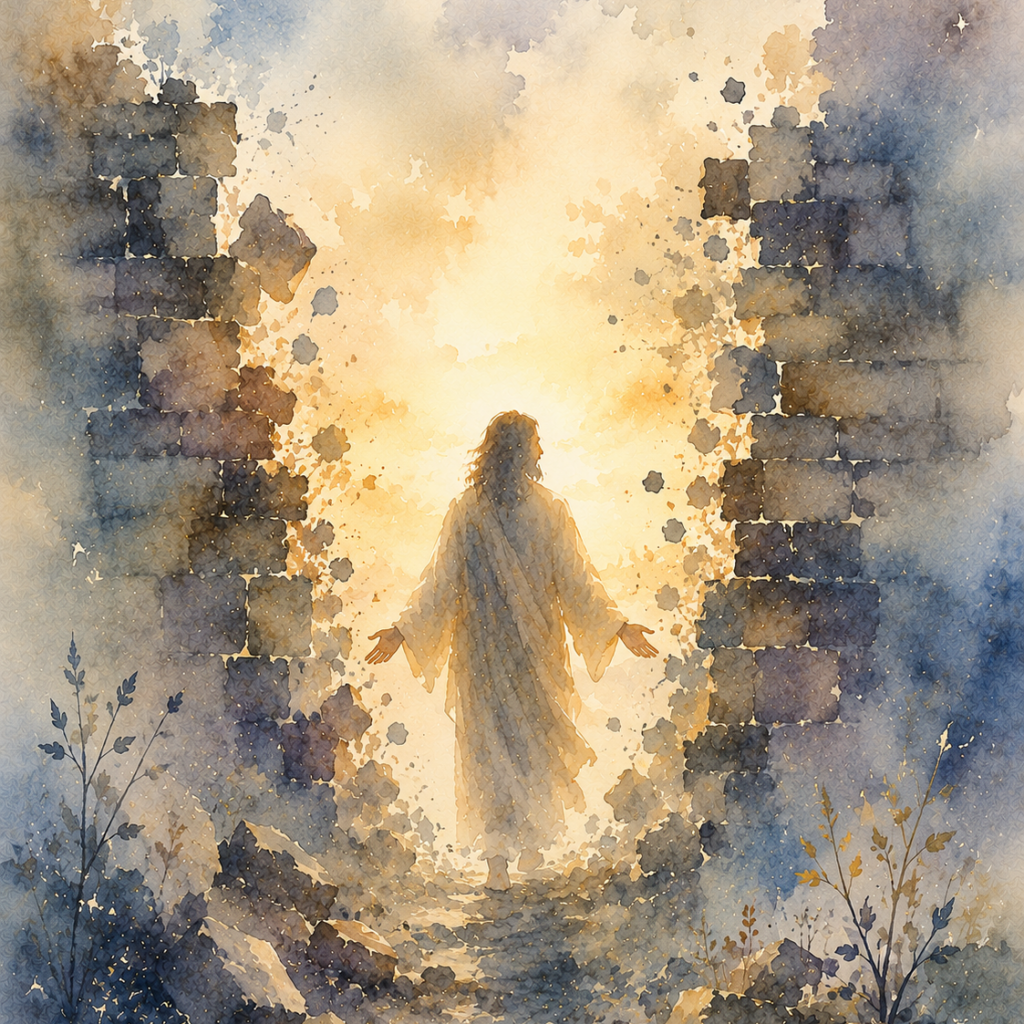
Remind us that your Church is more than brick and mortar. It is a living people, shaped by your Spirit and built through love. Every act of kindness, every word of grace, every hand extended in welcome, these are the stones from which your Church is built.
May our churches become places where healing is found, where differences are embraced, and where every person is treated with dignity as one created and loved by you.
Tear down every wall that keeps us from loving the world as Christ loves it.
By your Spirit, bind us together into a dwelling place of hope, mercy, and love. AMEN
Mid-Week Moment: The Walls We Carry
Ephesians 2:11-22
Most walls are built for a reason. They protect. They create boundaries. They keep what is precious safe from harm.
The same is often true of the walls we build within ourselves. Maybe they were built after a painful conversation that left us feeling vulnerable. Maybe after a betrayal that made trusting others seem too risky, we worked to protect ourselves. Maybe in a moment of disappointment, grief, rejection, or loss we raised our shield to avoid more pain.
At first, those walls may have served a purpose. They helped us survive. They gave us space to heal. But over time, the walls that once protected us can begin to isolate us. They keep out not only the things that might hurt us, but also the people who might love us.
In Ephesians, Paul speaks of Christ breaking down “the dividing wall” that separated people from one another. It is a powerful image, not simply of reconciliation with God, but of barriers falling between human hearts. That image invites us to ask an honest question:
What walls am I still carrying?
They might be walls of fear or resentment, walls built from assumptions about others. They might be walls of self-protection that have become so familiar we hardly notice they are there.
The good news is that Christ does not tear these walls down by force. The love of God is rarely forceful. Instead, Christ patiently invites us toward healing. Brick by brick. Conversation by conversation. Act of forgiveness by act of forgiveness.
Some walls may need to remain as healthy boundaries. Wisdom teaches us that not every gate should be left open. But there are other walls that no longer protect us, they simply keep us from experiencing the fullness of life, love, and community that God desires.
Part of following Christ is learning to recognize the difference, to ask not only, “What am I protecting?”, but also, “What might God be inviting me to open?” Because beyond some of the walls we carry may be the very grace, healing, or relationship our hearts have been longing for.
Take some time to sit with the reading this week (Ephesians 2:11-22) and with the following reflective questions:
- What walls have you built in your own heart, and what first led you to build them?
- Are there walls that continue to protect you in healthy ways, and others that may now be keeping love, grace, or connection at a distance?
- Is there a relationship, conversation, or act of forgiveness that God might be gently inviting you toward?
- What would it look like to trust Christ with one small brick this week?
Let’s pray:
Loving Christ, you are the one who breaks down the walls that divide us. With patience and compassion, help us to recognize the barriers we carry within our own hearts. Give us wisdom to keep healthy boundaries where they are needed, and courage to let go of the walls that keep us from love, healing, and deeper community. Brick by brick, shape us into people who are open to your grace and ready to reflect it to others. AMEN
Sacred Rhythms: Practicing Hospitality
Ephesians 2:11-22
There is a deep human longing to belong. We all want to know that we are seen, welcomed, and accepted for who we are. Yet it is easy to feel like an outsider, to wonder if we fit in or if there is truly a place for us.
In Ephesians, Paul reminds us that Christ has broken down the walls that separate us. Those who were once strangers have been brought near. Those who felt like outsiders have become members of God’s household. The good news of the gospel is not simply that we are welcomed by God. It is that we are invited to become people who extend that same welcome to others.
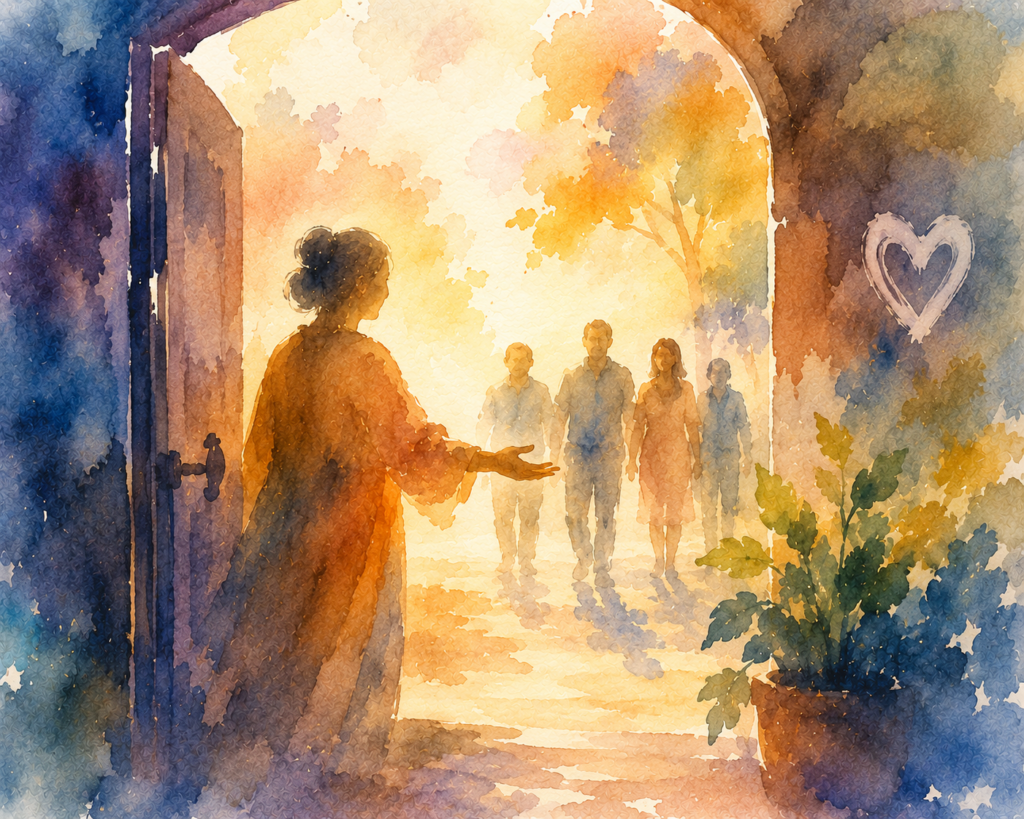
Hospitality is more than opening the door to our homes. It is opening the door to our hearts. Sometimes hospitality looks like inviting someone to share a meal. Other times it is making room for a new voice in a conversation, sitting beside someone who is alone, remembering a person’s name, or simply offering our full attention to someone who needs to be heard.
Small acts of welcome can remind people that they belong. And in those moments, we begin to reflect the heart of Christ.
This week, practice intentional hospitality. Each day, look for one opportunity to make room for someone else.
You might:
- invite someone for coffee or a meal
- introduce yourself to someone new
- reconnect with someone you haven’t spoken to in a while
- sit with someone who is alone
- offer your full attention during a conversation
- welcome someone who may be feeling like an outsider
Before you begin your day, take a quiet moment and pray:
“God, open my eyes to those who need to know they belong. Help me become a person who reflects your welcome.”
At the end of the day, take a few moments to reflect.
- Where did you experience welcome today?
- Where were you able to offer it?
Hospitality doesn’t require a perfect home, a carefully prepared meal, or grand gestures. More often, it begins with a willing heart. As we make room for others, we often discover that God has been making room for us all along.
Let’s pray:
Welcoming God, thank you for drawing us near through your love and making us part of your family. Open our hearts to those around us. Help us notice those who feel unseen, excluded, or alone, and give us the courage to offer a word of welcome, a listening ear, or a simple act of kindness. May our lives reflect your generous hospitality, so that others might catch a glimpse of your love through us. AMEN
Prayer Pause: Still Becoming
This week’s Prayer Pause is for anyone who feels like they are still finding their way. For those discovering who they are, who they are becoming, or wondering whether they are enough. May this prayer remind us that we are not unfinished because God has forgotten us – we are still being lovingly created, day by day, by the One who never stops making all things new.
God of new beginnings, thank you that your work in us is not finished. Before we knew our own names, you knew us. Before we understood who we were, your love was already shaping us.
And even now, you are still creating. With every sunrise, every conversation, every joy, every struggle, you continue the sacred work of forming us into people who reflect your grace.
When we become impatient with ourselves, remind us that growth cannot be rushed. When we compare our journey to someone else’s, remind us that every life unfolds in its own time. When we wonder if we have missed our purpose, remind us that your Spirit is still at work, calling us toward the people you are creating us to be.
Today we pray for all who are struggling to discover who they are. For young people searching for identity. For adults beginning again. For those whose confidence has been shaken. For those carrying questions they cannot yet answer.
Surround them with companions who encourage rather than judge, with communities where they can belong while they are still becoming, and with the assurance that they do not have to earn your love before they are worthy of it.
Help us to trust that we are more than our mistakes, more than our fears, more than the labels others have placed upon us.
We are your beloved, still being shaped by grace, still growing into compassion, still learning to love, still becoming.
We are your handiwork, your beloved creation, and you are not done with us yet. Amen.

Mid-Week Moment: Masterpieces in Progress
Ephesians 2:1-10
Have you ever watched an artist at work? At first, the canvas can seem confusing. A few scattered brushstrokes. Colours that don’t appear to belong together. Sections that look unfinished or even messy. If you judged the painting too early, you might wonder where it was going. But the artist sees something more.
Every brushstroke has a purpose. Every layer adds depth. Every colour contributes to a picture that is still unfolding.
In Ephesians, Paul writes, “For we are what he has made us…” Many translations say we are God’s “handiwork.” The Greek word Paul uses is poiēma, the word from which we get our English word poem.
It is a beautiful image.
We are God’s handiwork. God’s artistry. God’s ongoing work of creation.
That doesn’t mean our lives are already perfect. Quite the opposite. Like a painting still on the easel or a poem still being written, there are places where the work is unfinished. There are colours still being added. Edges still being softened. New beauty still emerging.
Maybe we should take comfort in that.
So often we become discouraged by the parts of ourselves that feel incomplete. We wish we were more patient. More courageous. More forgiving. More at peace. We compare ourselves to others and wonder why our own lives seem so unfinished.
But God is not surprised by unfinished things. The Artist has not stepped away from the canvas. Every experience of joy, every season of struggle, every lesson learned, every act of grace received, all become part of the masterpiece God is creating. Even the places we wish looked different are not beyond God’s ability to redeem.
The invitation of this passage is not to become someone else. It is to trust that God is lovingly shaping the person we are already becoming.
Perhaps faith is less about striving for perfection and more about allowing the Artist to keep working. With patience. With grace. With love. And maybe the most faithful thing we can do this week is to look at ourselves – and others – not as finished products to be judged, but as masterpieces still in progress.
Take some time to sit with the reading this week, and reflect with the following questions:
- What parts of your life feel unfinished or incomplete right now?
- When have you looked back and realized God was at work in ways you couldn’t see at the time?
- How might your view of yourself change if you truly believed you are God’s handiwork rather than a project to fix?
- Who in your life might need to be seen with the same patience and grace that God extends to you?
Let’s pray:
Creative God, thank you for calling us your handiwork. When we become discouraged by our imperfections or impatient with our growth, remind us that you are not finished with us. Help us to trust your loving hands, even when we cannot yet see the whole picture. Shape us with your grace, deepen us through your love, and teach us to see ourselves and one another as beautiful works still unfolding. AMEN

Sacred Rhythms: Noticing God’s Handiwork
Ephesians 2:1-10
It is often easier to notice our flaws than our beauty. We see our mistakes, our shortcomings, and all the ways we wish we were different. We can become so focused on what still needs fixing that we forget to notice what God is already creating within us.
In Ephesians, Paul offers a different perspective. He reminds us that we are saved by God’s grace, not because we have earned it, but because it is freely given. And then he writes these beautiful words:
“For we are what he has made us, created in Christ Jesus for good works.”
Some translations say we are God’s workmanship. The original Greek word, poiēma, is where we get our word poem. It carries the image of something carefully crafted, something shaped with intention, beauty, and purpose.
You are not an accident. You are not a project God has given up on. You are God’s handiwork, still being shaped by grace, still being formed by love, still becoming who you were created to be. Perhaps one of the greatest challenges of faith is learning to see ourselves and others through God’s eyes.
This week, take a few quiet moments at the end of each day to reflect on where you noticed God’s handiwork.
Begin with yourself. Ask: How did I see God’s grace at work in me today?
Maybe you found patience when you expected frustration, or you offered kindness instead of judgment, or maybe you found courage, forgiveness, or compassion in a difficult moment.
Then widen your reflection. Where did you notice God’s handiwork in someone else?
Maybe it was a generous act, a warm smile, a helping hand, or words of encouragement that lifted someone’s spirit.
Close your reflection with this simple prayer:
“Creator God, help me see your beautiful work, in me, in others, and in the world around me.”
Over time, this practice can reshape the way we see ourselves. We begin to notice not just our imperfections, but also the ways God’s grace is continually creating something beautiful within us.
Let’s pray:
Creative and Loving God, thank you for forming us with care and surrounding us with your grace. Open our eyes to see your handiwork in our own lives, in the people we meet, and in the world you continue to renew. When we focus on our flaws, remind us that we are still being shaped by your loving hands. May we live each day with gratitude, humility, and confidence, trusting that the work you have begun in us is not yet finished. AMEN
Prayer Pause: Known By Heart
John 10:1-21
This week’s Prayer Pause is for anyone feeling uncertain, unsettled, or a little lost. For those trying to find their place, find their footing, or make sense of who they are becoming. May this prayer be a reminder that even in seasons of wondering, we do not walk alone, we are known by heart.
Let’s pray:
God who knows us more deeply than we know ourselves, today we pray for all who feel lost. We pray for those trying to find their place in the world, for those trying to find their feet after change, disappointment, or loss, for those asking questions about who they are, where they belong, or what comes next.
We pray for those who feel behind, for those who feel uncertain, for those carrying the fear that everyone else seems to know the way. Meet them with gentleness.
In a world that tells us we must have everything figured out, remind us that faith is not always about certainty, it is often about trust. In a world that asks us to prove ourselves, remind us that we do not earn belonging. In a world that can make people feel invisible, remind us that we are already known.
We are not known as projects to be fixed, for what we achieve, or only by our successes or failures. We are known by heart.
You call us by name. You see who we are and who we are becoming. You walk with us before we find our footing and remain with us long after.
For all who are wandering, be their companion. For all who are weary, be their rest. For all who feel alone, remind them that they do not walk alone.
May they know that they are held by God, partnered with Christ, and guided by the gentle breath of the Spirit. And where paths seem unclear, give courage for the next small step.
Because even when we do not know the way, we are known by the one who journeys with us. AMEN

46 Main Street
Fredericton, New Brunswick
E3A 1C1
506-458-9452 (Church Office)
506-262-2150 (Rev. Richard's Cell)
Office Hours
Tuesday - Friday 9am to 2pm
Rev. Richard's Drop-in Office Hours
Tuesday & Thursday 10:00AM to 12:30 PM
We dedicate the revitalization of our online presence to the memory of the late Mary Hicks. We are grateful for Mary’s personal estate bequest in support of the work and mission of Nashwaaksis United Church.